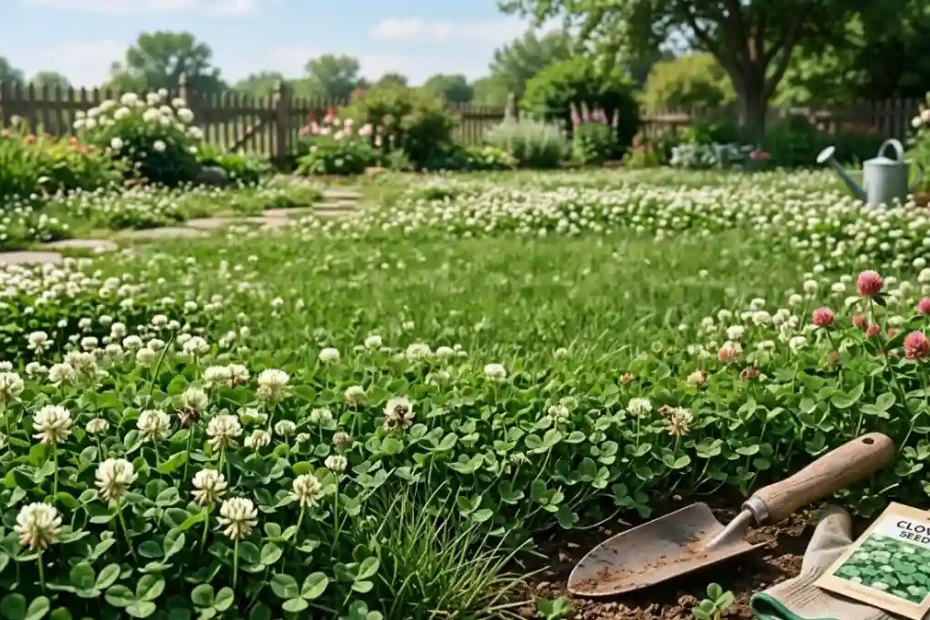
Same plain, boring grass cover? Turning yellowish when dry, at times getting spiky, uneven edges as you slightly tread into your backyard? If you have felt the same (or feel rather), then clover is an amazing alternative for a soft, fresh green lawn makeover. Yup!
And after all, who has got so much time for frequent trimming to keep grass in shape?
If ‘clover’ sounds new to you, then lemme get to its roots.
(A gentle request; don’t mix up clover with clove!)
Why Choose a Clover Lawn?
Having three (sometimes four) small, round leaves, with kinda whitish, pink, or reddish flowers growing out from within, they simply look wonderful.
You know what, most of the time, this low-lying plant seems like a weed to people (It’s just the perspective, nothing else). Growing up so fast and spreading like a soft, velvety lawn that clover makes you fall in love with it every time your feet touch the ground. Comfort, indeed!
But these tiny, resilient, and humble cuties are actually very helpful in many ways.
When I heard about them from a friend some time back, I never had in mind that they would be such amazingly ‘low-maintenance’ greens. No grand requirements, extra care, blah blah.
The seeds sprouted so gleefully within five days. Three weeks later, they covered my entire backyard. The best part is that on some days now, even if I forget to water my ground regularly, they still remain perfect. Perfectly fresh and green (all thanks to their roots). Also, there’s no mowing hassle, as mentioned before.
And the list continues…
Clover fixes nitrogen naturally into the ground, thus restoring soil health and improving fertility in the long run. Planning to grow an organic vegetable garden at your home? Clover will take the responsibility!
Quick read: How to Improve Soil Fertility Naturally: Top 5 Cheapest Hacks
Let’s learn how to transform a grassy lawn into a clover lawn.
Right from the start..
Sowing time and rate
It’s best to sow the seeds during early spring, when the temperatures are not extreme, with perfect moisture and shade. The onset of autumn also favours germination and overall growth. But do avoid the scorching mid-summer, for the seeds might get cooked!
For a complete cover lawn, sow at 5–10 g per m² of land. The dense growth afterwards will just amaze you. However, in case you wanna keep both grass and clover, 1-2 g per m² is ideal.
And wait. Before you sow clover seeds, some land prepping is needed. Come learn the steps.
Step 1 – Prepare the planting area
Mow existing grass short and remove heavy thatch, debris, and excessive plant material. If you are establishing clover from bare soil, remove competing vegetation and prepare a fine, level seedbed.
Step 2 – Prepare the soil
Loosen the upper layer of soil lightly and create a firm, fine seedbed. Avoid creating large clods. Clover seeds are small, so good seed-to-soil contact is important.
Also, keep in mind to broadcast them uniformly. Spacing the seeds too closely will make them compete against each other, which you will definitely not want.
Step 3 – Keep the seedbed evenly moist
Water gently after sowing and keep the soil consistently moist while the seeds germinate. Avoid waterlogging, which can create poor conditions for young seedlings.
Step 4 – Give seedlings time to establish
Well, now that you have sown and watered the seeds, let them germinate, mate! Avoid heavy foot traffic while the seedlings are becoming established. Begin mowing only after the plants have developed enough growth to tolerate cutting.
I remember my clover seeds started popping out into baby plants from day 5 of sowing. Then, waited for about two and a half weeks; they were already growing by that time.
(Note: For easier seed sowing, you can mix some parts of sand into your soil.)
Clover growth timeline
| Development stage | Time | What to expect? |
| Germination | 7 – 10 days | Small green sprouts when the right humidity and temperature (slightly above 15°C) are met |
| Seedling Stage | 2 – 3 weeks | The plant begins to develop true leaves (clover shape), and roots begin to spread. |
| Ready for Lawn/Ground Cover | 4 – 6 weeks | It begins to cover the ground, making it ready for light use or light grazing. |
| Fully Mature | 8 – 12 weeks | The plant becomes completely dense, its roots become strong, and it is ready to flower. |
How to care after the clover seeds have sprouted?
You will be overjoyed with those little greenish clover heads springing up, swaying this way and that. Happens within a month or so.
Ensure not overwater them. Just once a week is enough, except if you are staying in extremely dry and hot areas.
Let me tell you why.
Water pooling near the clover’s roots gives them fungal patches, and the plant slowly weakens. My point is – they just don’t require so much water at all. Just let them be themselves!
See here: 5 Common Fungal Diseases in Plants: Identification, Impact, and Management
Clover is quicker than grass to grow. Mine took almost three months to completely fill in the land. However, in some parts, even if you see some bare patches, just chill. Give them a bit more time and see the magic.
Once the clover is established, mow according to the height and appearance you want. Regular mowing can help keep clover low and lawn-like, while allowing some plants to flower can provide nectar for pollinators.
If you are fond of flowers, then mowing is not recommended. When clover bears its first flowers, they attract several pollinators.
(Now, that’s a seriously controversial point – let the decision be up to your household!)
Well, you should also be aware of the weeding problem. If you see anything that is growing all out at once and getting entangled with the clover, manually pull them out. Do not use any kind of herbicide, or else that might affect the clover too. In maximum times, that may even kill your actual plant much before the weeds.
What clovers dislike? Planting mistakes that you should avoid
Dense, clayey lands
Soggy soil that makes your feet wet is a big ‘NO’ for clovers. Either ensure proper soil drainage or balance the clayiness with sandy soil.
Heavy frost
If your area is prone to snowfall and it is already winter, avoid sowing your clover seeds. Wait for the chilly season to subside, and the snow to disappear.
Dark shade
Clover loves sunshine. Make proper arrangements so that they get plenty of it. Avoid planting big canopy-like trees in your lawn.
But this does not mean you can just plant it amidst scorching sun rays. ‘Too much’ is good for nothing!
Nitrogenous fertilizer use
Clover can fix atmospheric nitrogen through its relationship with soil bacteria, so established clover generally has a low nitrogen requirement. Avoid routine nitrogen fertilization unless a soil test or your specific grass-clover system indicates a need.
If you are growing clover with grass, fertilizer requirements can differ from those of a pure clover lawn.
Existing plant residues (treated)
Your land may have some plant debris from the previous batch that are treated with broad-spectrum herbicides. If you do not remove them, they may kill your clover seedlings. So, beware of that.
Burying them too deep or too shallow
Clover seeds are extremely tiny, so please do not sow them too deep. Plant them on a moderately shallow level (about a quarter inch depth) so that they have a proper contact with the soil. But, again, not loosely on the ground. The birds or small animals may eat them up.
Which clover to plant?
Oh, one thing I missed out on to tell. There are many types of clover, and not just one.
I planted the one bearing red flowers. But the others are beautiful too. Each has different growing habits and visible features – sharing with you below:
Red Clover (Trifolium pratense)
- Slightly taller than others.
- Larger leaves with pinkish-red flowers.
- Roots are deep (good for soil fertility and texture maintenance).
- Drought-resistant.
- Good source of fodder for pets or domestic animals.
Crimson Clover (Trifolium incarnatum)
- Flowers annually with vibrant dark red flowers that attract several pollinators.
- Tallest amongst all other types.
- Medium to deep roots.
- Can be grown along with grass or wildflower mix. If you plant individually, it is a very good cover crop.
- Very fast-growing and keeps the soil covered during winter so that fertile soil does not get washed away. Also, good for enhancing the aesthetic appeal of garden lawns.
- Easily convertible to green manure. You can mix the mulch and prepare the ground for the next season.
White Clover (Trifolium repens)
- The most popular for lawns.
- Best for complete lawn cover.
- Grows on lower levels, has shallow roots and creeping stems.
- Good for mowing and also allows some level of foot traffic by you or your pets.
- The small white flowers attract bees, adding to the beauty of your home lawn.
- If you have small pets, they can munch on the clover. Natural mowers, in fact! This aids in better growth of the plant.
Alsike Clover (Trifolium hybridum)
- It looks like a mixture of white and red clover and thrives best in cool, moist weather.
- Best for green pastures. No doubt, they are a good source of cattle feed.
- Thrives well in cooler areas with naturally wet, acidic soils.
- Has medium to deep roots.
- Bi-colored flowers (white-pink, light red, etc.)
Micro Clover (Trifolium repens var. ‘Pirouette’ )
- ‘Micro,’ as its name is, has very tiny leaves with a compact growth habit.
- Hardly flowers, ideal for those who do not require visible blooms and just need soft, green, velvety lawns.
- Best for fully covered lawns. Or, if you want, integrate some fine grass with it.
- To keep the height short, mow it frequently.
| Type of clover | Flowering time | Flower color | Good for | Best Use |
| White clover | Perennial | White | tolerate foot movement | Lawn and Ground Cover |
| Red clover | Biennial/Perennial | Pink/Red | drought tolerance | nutritious animal feed |
| Crimson Clover | Annual | bright dark red | rapid growth | Green manure and cover crops |
| Alsica Clover | Perennial | light pink | Tolerates wet/acidic soils | waterlogged areas |
Wrapping up
Clover is a simple plant, with even simpler requirements. Everything is minimal – effort, watering, fertilizers- but still aesthetically hitting the best! Softer, somewhat wilder than the conventional grass.
Now that you have an idea of how to plant a clover lawn, just keep in mind not to overcare. Either plant it individually or associate it with grass. For more such insightful blogs on farming, subscribe to Farm.ws.
Frequently Asked Questions
Wait until the clover is well established before mowing. After establishment, mow according to the desired lawn height and the clover variety. Regular mowing can keep clover low, while less frequent mowing allows it to flower and provide resources for pollinators.
Newly planted clover should be kept evenly moist while it establishes. Once established, clover is relatively drought-tolerant and generally needs less supplemental watering than many traditional lawn grasses.
Established clover generally has a low nitrogen requirement because clover can fix nitrogen through its relationship with soil bacteria. If nutrient deficiencies are suspected, a soil test can help determine whether fertilizer is necessary.
White clover can grow across a range of soil types, but it performs poorly in very acidic or waterlogged conditions. Good drainage and adequate sunlight are important.