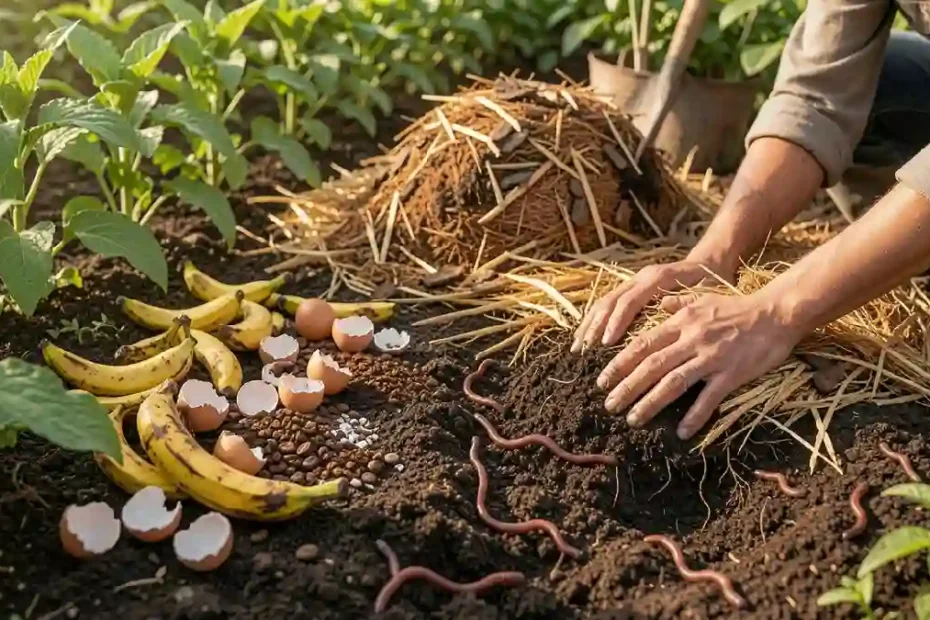
Every gardener knows that “Fertile soil means healthy soil.” But what about the high costs of chemical fertilizers, this and that..ughh! And, if you think beyond this, chemical practices most likely destroy your soil health in the long run, even polluting other valuable resources like water.
Then, what’s the solution? Something eco-cum-pocket friendly!
So yes, I have come today to guide you on how to improve soil fertility naturally, whilst managing your budget as well. Read on..
5 Inexpensive & Proven Natural Ways to Nourish the Soil
Organic Composting
Recharging soil nutrients is the easiest thing to do when you have spoiled kitchen scraps with you. Just make a deep pit in your backyard, collect the organic waste there, and then cover it with a thin layer of soil.
Leave it aside for one to two weeks, and the materials will turn into ‘Black gold’, i.e., decompose completely into manure.
Freely mix it into your land as much as possible – no side effects, nothing!
Mulching
Apply a thin protective layer of unused organic material on your soil, ‘mulch’, and see how it magically improves soil integrity, conserves moisture while replenishing lost nutrients for better plant growth.
How to mulch? Spread dry fallen leaves, tree bark, dead plants, straw and wood waste, animal droppings, and compost evenly onto your soil and let them rot over time.
Gradually, the mulch will start to release nutrients into your soil, and tadaaaa….!!
Crop rotation with legume & cereal planting
Sowing different plants at different seasons in the same land is highly beneficial for the soil. Plus, it controls harmful, disease-causing pests. But, how?
Simple. Not all plants have the same nutrient needs. So, when you grow different crops or plants, the chances of soil getting depleted of one specific nutrient and your plants eventually falling ill are the least.
For best results, pair up leguminous crops, like peas, beans, or cereals like barley, bajra, etc., with the staple plant. They are low in cost and maintenance, yet the superior-quality natural nitrogen boosters for your soil!
Growing cover crops
Cover cropping is mainly for soil health improvement, rather than for consumption. This involves planting off-seasonal greens along with your main plant (or crop).
Once they attain medium maturity, you cut and till (green manuring) or leave them as they are in the same land (green mulching).
Why is it useful? Protects the soil layer from erosion, drying up, or freezing, clears pests and weeds, improves texture, and restores nutrients to the soil.
Introducing earthworms into soil
Yes, all of you have guessed it correctly – I am talking about ‘vermicomposting’.
When it comes to improving soil fertility naturally, these small, harmless, slippery crawlers are indeed the soil’s best friend! They naturally till the deeper soil layers while moving, facilitating optimal air circulation.
Moreover, they feed on the soil and deposit their valuable excreta enriched in organic matter. Anything more to ask?!
Precautions & Tips to Maintain Soil Fertility
While you can apply the above natural ways to restore your soil’s health, maintaining its fertility for a sufficiently long period of time is equally crucial.
Here are some extra things to keep in mind:
- Say ‘NO’ to harsh ploughing
Too much tilling damages the soil’s structural integrity, exposing inner organic components to the air. This also disturbs the soil ecosystem, potentially killing the useful organisms that live inside. Over time, you can notice a sharp drop in soil fertility – thus, stop the practice before it’s too late!
Gently plough the land to remove the weeds and make new seedbeds, when needed (not frequently).
- Avoid using bulky machinery on land
Modern cultivation often promotes the use of heavy tractors and machines alike. However, it is extremely harmful to soil health over time. How? Because that hardens the soil too much for sufficient gaseous exchange and water seepage to happen.
And the result? A disrupted soil microbiome featuring poor plant development.
- Do not flood the soil
Water is, of course, needed for land preparation. However, do take care not to overuse it, as that can strip all the essential nutrients from the soil, transporting them far deeper than the root level. The phenomenon is called ‘leaching’.
Another culprit is ‘waterlogging’ near roots, decreasing the oxygen uptake of plants. Unless controlled, it can lead to unwanted fungal growth and infection spreading to other healthy plants through the soil.
So, a balanced approach to watering is the ‘key’!
- Not ‘too much’ fresh manure
Anything beyond limits is harmful, and this is equally applicable to organic manure application into the soil.
Excessive manuring increases soil pH levels, making it too alkaline for plant growth. Instead, you can use vegetative compost in considerable amounts (always know when and where to draw a line). Let me tell you why.
Manure is raw animal excreta enriched in nitrogen and other inorganic waste, replenishing soil nutrients quite rapidly. However, the ‘con’ is that it also leads to high salt accumulation, potentially affecting the plant roots (It’s better to administer ‘aged manure’).
In contrast, compost is decomposing plant matter, being slower and comparatively gradual in releasing nutrients into the soil. Much safer option!
5 Best Kitchen Scraps to Recycle & Naturally Improve Soil Fertility
Hey ‘green-lover’! Are you ready for some really good news?
Rush to your kitchen right now, as I tell you about some of the best and cheapest natural items to improve your soil. Quick!
- Banana peels
Yes, the bananas which you gulp down before workouts, and for breakfast – full of starch and potassium! You can now recycle their leftover peels to enrich your soil with potassium and grow beautiful plants.
Best for – flowering shrubs, e.g., Rose.
- Coffee grounds
From now on, do not throw the coffee grounds after brewing your favourite coffee. Why? Because they are extremely soil-friendly, replenishing nitrogen in the most natural way.
Is that all? No..
Coffee grounds are also a storehouse of other micronutrients like potassium, phosphorus, and magnesium, etc. Lightly mix them with compost and spread them over the soil – you are done!
Besides, it will maintain optimal water retention and drainage, and aerate the soil.
Best for – Lilies, blueberries, etc.
- Egg shells
Made up of calcium carbonate, eggshells are a rich source of calcium to give to your soil. Other than calcium, nitrogen, and phosphorus are also present to boost fertility. And what to do with the egg-boiling water? Do not throw it; instead, water your soil with that.
Best for – Tomato plant, chilli plant, etc.
- Rice water
If you have been pouring off the water down the drain after boiling rice every time, stop it! That water is rich in natural starch and is beneficial for soil microorganisms that organically fix nutrients. Also, small quantities of essential vitamins and minerals remain in that rice water.
Best for – all kinds of plants and crops
- Coconut husk
Perfect for mulching, coconut husk offers an additional protective layer on the soil, keeping its nutrients intact. Also, it helps control weeds and enhance soil texture while supplying starch to the soil.
Best for – Orchids, ferns, and houseplants, etc.
Final thoughts
In 2026, knowing how to improve soil fertility naturally is a must. Today, every farmer and planter alike is voting for sustainable produce with minimal use of fertilizers. Do you know why? First, of course, for greater profitability at lower input costs and second, for environmental causes.
By following the above simple and completely natural techniques, I hope you can achieve a lot in your planting journey, and that too in the cheapest version. Follow and stay with us for more such informative & interesting content!
FAQs
They are almost the same, with the only difference being that manure is the raw animal waste, while compost is the decomposed plant waste. Manure is quick to replenish soil nutrients, and compost gradually releases them.
Add manure to your soil and mulch it often. However, it is advised not to use manure excessively, for it can lead to saline stress and ultimately damage the soil. You can use compost in moderate amounts.
You can use fireplace ash, paper rubbish, pencil shavings, fish and chicken bone residues, strained tea leaves, rotten food, etc.
Yes, definitely you should. It is the most cost-effective way to understand what nutrients your soil lacks and accordingly plan how to improve soil fertility naturally.
Pingback: Top 5 reasons explained: Why soil testing is so important in agriculture?
Pingback: How To Plant Mustard Seeds: A Simple Step-By-Step Growing Guide
Pingback: How to Plant a Clover Lawn: A Step-by-Step Guide - Farm