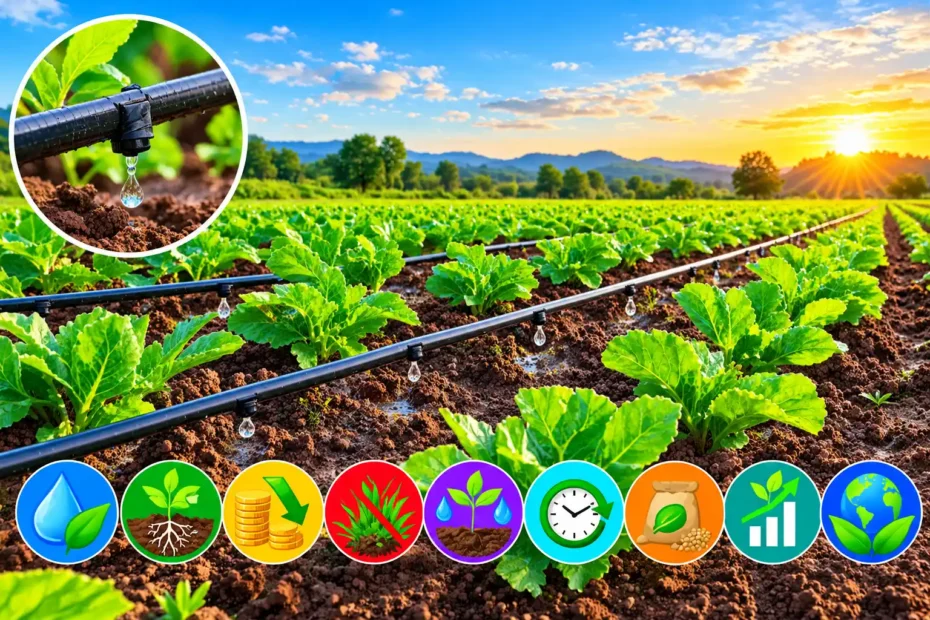
Water is the most expensive input a farmer cannot afford to waste. The advantages of drip irrigation start right there: instead of flooding a field or spraying water into the air, a drip system delivers water slowly and directly to the roots of each plant. That small change affects water use, yield, labor, fertilizer, and even plant health.
But drip irrigation is not free of trade-offs. It costs money to install, and it needs regular care. This guide covers the nine biggest benefits, the real costs, a simple payback example, and how drip compares with sprinkler and flood irrigation, so you can decide whether it fits your farm or garden.
| Quick answer: The main advantages of drip irrigation are major water savings, higher yields and crop quality, lower labor and energy costs, more efficient fertilizer use, fewer weeds, less leaf disease, and reduced runoff and erosion. The main drawbacks are the upfront cost, clogging, and maintenance. |
What Is Drip Irrigation?
Drip irrigation, also called trickle or micro-irrigation, is a method that releases water drop by drop at or near the root zone of a plant. A typical drip irrigation system includes a water source and pump, a filter, a pressure regulator, mainlines and sub-mains, drip tape or drip lines, and emitters.
Because water goes only where the crop needs it, very little is lost to evaporation, deep percolation, or runoff. Oregon State University’s irrigation guide notes that a well-designed system loses practically none of its water to runoff, deep percolation, or evaporation.
If you are new to the broader topic, start with our guide to irrigation and its main methods and then come back here for the drip-specific details.
9 Advantages of Drip Irrigation
1. Major Water Savings
This is the headline benefit. Published figures vary: some irrigation suppliers say drip uses 30-50% less water than traditional surface irrigation, while others claim savings of up to 70% compared with older methods and sprinklers.
Why such a wide range? The saving depends on what you compare against, your soil, your crop, the climate, and how well the system is designed and managed. Savings are biggest when you replace flood irrigation on sandy, hot, or windy sites. They are smaller if your old system was already efficient.
For regions facing falling water tables, this matters. Pair drip with the practices in our guide on water conservation methods in farming for the biggest effect.
2. Higher Yields and Better Crop Quality
Steady, targeted watering keeps soil moisture even, which reduces water stress in the plant. Fewer swings between too dry and too wet usually mean more uniform crops, better fruit size, and fewer culls. Irrigation companies and extension sources consistently link drip systems to improved yield and quality, and that is where much of the extra income comes from.
3. Lower Labor Costs
Once installed, a drip system can be switched on with a valve or run automatically on a timer or controller. You no longer need workers to move pipes, open and close field channels, or stand by with a hose. For small farms where labor is hard to find at peak season, this is a real relief.
4. Efficient Fertilizer and Chemical Use
Drip makes fertigation possible: dissolving fertilizer in the irrigation water and applying it straight to the root zone in small, frequent doses. Plants take up nutrients more efficiently, less fertilizer is wasted or leached below the roots, and you can feed the crop in step with its growth stage. Before injecting any chemical through the system, make sure the product label allows application through drip irrigation.
Fertigation works best when you know what your soil already contains, so a soil test is a smart first step.
5. Fewer Weeds
Because water reaches only the crop row, the soil between rows and on unplanted areas stays dry. Weed seeds there have less moisture to germinate, which can cut weeding time and herbicide use.
6. Less Leaf Disease Pressure
Sprinklers wet leaves, stems, and fruit, which creates the damp conditions many fungal and bacterial diseases like. Drip keeps the foliage dry, so there is less contact between water and the aboveground parts of the plant. If you grow tomatoes, cucurbits, grapes, or other disease-prone crops, this is a big plus. (Dry leaves do not mean disease-free crops, so keep scouting. Our overview of fungal diseases in plants helps with identification.)
7. Lower Energy Costs
Drip systems usually run at lower pressure than most sprinkler systems. Lower pressure means smaller pumps and less energy for pumping, which matters most if you rely on diesel or on electricity from a borehole.
8. Works on Uneven Land and Different Soils
Water applied slowly does not run off sloping ground the way flood or fast sprinkler application can. Drip also lets you adjust how often and how long you irrigate to suit light or heavy soils, and you can irrigate irregular plots and orchards where other methods struggle.
9. Less Erosion and Runoff
Slow, controlled application reduces surface runoff and soil erosion, and it limits fertilizer and pesticide movement into nearby ditches and waterways. That makes drip a good fit for farmers working toward more sustainable agriculture.
The Costs and Disadvantages to Know Before You Install
An honest look at the advantages and disadvantages of drip irrigation helps you avoid expensive surprises.
- Upfront cost. Oregon State University’s extension guide puts typical drip systems at roughly $500 to $1,200 or more per acre. Your actual cost depends on crop spacing, field layout, filtration, and whether you use surface or subsurface lines.
- Clogging. Emitters block easily when silt, algae, or mineral deposits are not removed by good filtration. Clogged emitters mean uneven watering and stressed plants.
- Maintenance. You need to check pressure, flush lines, clean filters, and inspect for leaks regularly. Neglect is the most common reason a drip system underperforms.
- Sun and animal damage. Exposed tubing can degrade in strong sunlight, which shortens its life. Rodents and other animals may also chew lines.
- Drip tape waste. Thin drip tape is often single-season and has to be collected and disposed of after harvest, which adds cleanup cost.
- Needs good design. Land slope, soil type, water quality, crop, and climate all affect layout. A poorly designed system wastes money, water, and time.
- Not ideal for everything. Drip may be unsuitable where herbicides need sprinkler water to activate, and in some light soils subsurface drip may not wet the surface enough for seeds to germinate.
- Salt buildup. If your water is saline, salts can accumulate at the edge of the wetted zone and may need periodic leaching.
Drip vs Sprinkler vs Flood Irrigation
| Feature | Drip irrigation | Sprinkler irrigation | Flood (surface) irrigation |
| Water efficiency | Highest | Moderate | Lowest |
| Upfront cost | Higher | Moderate | Lowest |
| Labor needed | Low once installed | Moderate | High |
| Energy / pressure | Low | Higher | Low (gravity-fed) |
| Fertilizer application | Precise (fertigation) | Possible but less precise | Uneven |
| Leaf wetting / disease risk | Low | Higher | Low to moderate |
| Weed growth | Lower | Higher | Higher |
| Clogging risk | High without filtration | Low to moderate | None |
| Best for | Row crops, vegetables, orchards, gardens | Field crops, pastures, lawns | Flat fields with plentiful cheap water |
For a closer look at the other options, see our article on the sources of irrigation.
Is Drip Irrigation Worth It? A Simple Payback Example
The easiest way to judge drip irrigation is to estimate how long it takes to pay for itself:
Payback period (years) = System cost per acre ÷ Net annual gain per acre
Here is an illustrative example only; your numbers will differ:
| Item | Amount per acre |
| System cost (installation) | $900 |
| Extra income from higher yield and quality (per year) | $300 |
| Savings on water and energy (per year) | $120 |
| Savings on labor and fertilizer (per year) | $130 |
| Less: yearly maintenance and replacement parts | -$50 |
| Net annual gain | $500 |
| Payback period | about 1.8 years |
High-value crops such as vegetables, berries, and orchard fruit tend to pay back faster because the extra yield and quality are worth more per acre. Low-value field crops on cheap, abundant water can take much longer. Always run the numbers with your own prices, crop, and water costs.
In India, central and state governments run schemes that support micro-irrigation, such as the Pradhan Mantri Krishi Sinchayee Yojana (Per Drop More Crop). Subsidy rates and eligibility differ by state and category, so check with your local agriculture or horticulture department before you buy.
How to Get the Most From a Drip System
- Test your water and soil first. Know your water’s silt, salt, and mineral content before choosing filters.
- Invest in filtration. A proper screen or disc filter is the cheapest insurance against clogging.
- Use a pressure regulator. Even pressure means even watering along the whole line.
- Flush lines regularly. Open the line ends to clear sediment, especially at the start and end of the season.
- Match emitter spacing to your crop and soil. Sandy soils need closer emitters; heavy soils spread water farther sideways.
- Add mulch. Mulch over drip lines further cuts evaporation and weed growth.
- Start small. Try one plot or bed first, learn the system, then expand.
- Inspect often. Walk the rows after each irrigation in the first weeks to spot leaks and blocked emitters.
Drip also fits well with other modern farming methods and with data-driven approaches like precision agriculture, where soil moisture sensors and controllers decide when and how much to irrigate.
Who Should Use Drip Irrigation?
Drip is a strong choice if you grow row crops, vegetables, fruit trees, or vines; if water is scarce or expensive; if labor is short; or if you want precise fertilizer control. It is also excellent for home gardens and greenhouses. It is a weaker fit for very low-value crops on abundant cheap water, or for farmers who cannot commit to regular maintenance.
Conclusion
The advantages of drip irrigation are clear: it saves water, supports higher yields, cuts labor and energy, and makes fertilizer go further. The costs are just as real: a meaningful upfront investment and a steady maintenance routine. For most vegetable, orchard, and water-scarce farms, the long-term gains outweigh the costs, especially when you plan the system well and protect it with good filtration. Run a simple payback calculation for your own land, start with a small plot if you are unsure, and scale up from there.
Read More
- The Blue Revolution: Essential Water Conservation Methods for Sustainable Farming
- How Is Precision Agriculture Transforming Sustainable Farming?
- Top 5 Reasons Why Soil Testing Is So Important in Agriculture
- 7 Advantages of Sustainable Agriculture for Farmers and the Environment
Frequently Asked Questions
Drip irrigation saves water, can raise yield and crop quality, cuts labor and energy use, allows precise fertilizer application, reduces weeds and leaf disease, and limits runoff and erosion.
Reported savings range from about 30-50% compared with surface irrigation, and some sources cite up to 70% versus traditional methods and sprinklers. Your actual savings depend on your crop, soil, climate, and system management.
The main disadvantages are the upfront cost, clogged emitters, regular maintenance, tubing damage from sun or animals, drip tape cleanup, and the need for good design.
Oregon State University Extension reports that drip systems typically cost around $500 to $1,200 or more per acre. Costs in your region will vary with crop spacing, materials, and installation.
Vegetables, fruit trees, grapes, berries, sugarcane, cotton, and plantation crops commonly use drip, along with greenhouse and home garden plants. Widely spaced row crops usually benefit most.
Yes. Timers, controllers, and soil moisture sensors can run a drip system with very little manual work.