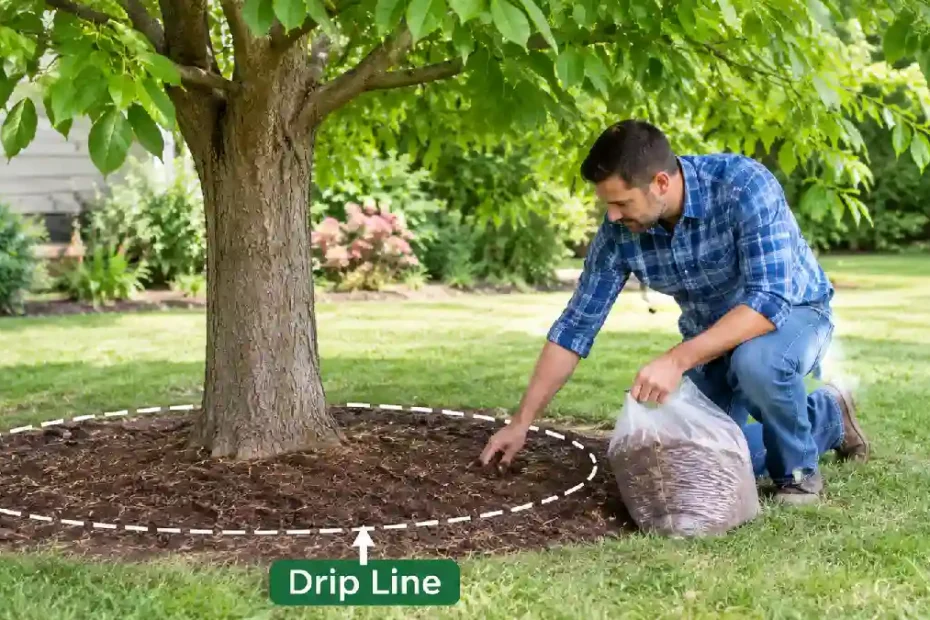
Quick answer: The drip line of trees refers to the imaginary line where the tree’s branches extend. These drip lines are essential to prevent direct application of fertilizer, water, and insecticides at the root of any plant. Most importantly, this imaginary line helps rainwater drip down to a specific place.
Why Does the Drip Line Of A Tree Matter?
Drip lines are helpful in many ways. The main benefits are,
Root Vitality
Most feeder roots sit in the top 12 inches of soil and spread out to and beyond the drip line. From these places, the roots can easily get the needed water, food, and nutrients and supply them to the whole plant. So if you apply fertilizers or water to its central roots, it will not work; rather, it will weaken the main root.
Right Amount Of Water Consumption
If you add water to the tree trunks, then stop it now. Trust me, watering at the trunk won’t reach most feeder roots, as the right amount of water a plant consumes comes from the driplines where the raindrops are dropped.
Effective Fertilizing
The drip line area of a tree is an effective zone that helps the tree absorb nutrients from the soil. Whether you put any fertilizers, its roots absorb them from the drip lines.
Mulching Process
Mulching is a natural process for storing nutrients and is effective at the drip lines. If you support the mulching process, it will create a better way to get organic fertilizers and nutrients.
What Is the Drip Line of a Fruit Tree?
It is the same as I explained at the bottom of this page; it is the same as the other trees, except for the long-trunk trees. If you are a fruit gardener and want your plants healthy, then keep focus on its drip line. Want to know how? Here are the solutions
Solution 1: Water the plant from its drip line
Solution 2: Apply the fertilizers at the dripping bottom
Solution 3: Gather the mulching elements like dry leaves at the drip line, but avoid adding them in the center
What Is the Drip Line of a Palm Tree?
As palm trees have a straight structure, they set their drip line a little differently. This tree doesn’t have many branches; it has a single trunk with fronds at the top. So its drip line refers to the circle beneath it. If you are taking care of the palm tree, then you need to know about its differences from other plants.
What Is the Drip Line of an Italian Cypress Tree?
Italian cypress is tall and slender, so its drip line sits very close to the trunk, often only a couple of feet out. That can make it tempting to water right at the base, but the roots usually reach beyond the visible canopy.
Best Practices for Drip Line Research for Trees
Before discussing drip line research for trees, it is very important to know why the research is required. In my opinion, various reasons cause the research, but the most important is to understand the soil condition, water needed, and the nutrition it can take from the drip lines. Some other practices for the research are,
Identify The Drip Line
- Observe the canopy
- Measure the length from trunk to line
- Identify the specific place to water
- Mark the lines
Look For The Root Distribution
- Measure the distance of roots from the trunk
- Water validity should be checked before water transfer
- Always check the soil and root condition
The Soil Condition
- Research the soil texture, condition, and efficiency
- Check the soil types before watering
- Observe how quickly it can be absorbed
Measure the Water Requirements
- Research and understand the water consumption capacity
- Avoid excessive watering
- Always check the moisture level of the soil
How to Water at the Drip Line
If you have a big garden or cultivation area, you must find the way or methods of Drip Line Irrigation. In this guide, you will get some simple ideas about how to do drip line irrigation. These methods will not only help you to gain knowledge but also help you to save your plants for a longer time.
Method 1: Inline Drip Irrigation
- Lay pipes for the drip lines
- Set them according to the distance
- This will help to distribute water equally
Method 2: Loop drip method
- The loop is positioned within the active root zone.
- Multiple emitters distribute water around the tree.
- The loop can be expanded as the tree grows.
- Suitable for individual fruit trees and landscape trees.
Method 3: Double-line irrigation
- For the long and upper trunk, use this method
- Set the pipes in vertical lines
- It is useful for mature trees with wider root systems.
Method 4: Online drip irrigation
- Emitters can be installed wherever water delivery is required.
- Their number and placement can be adjusted according to tree size.
- It offers flexibility for trees with different water requirements.
Conclusion
Drip line plays a vital role in planting and agriculture. Its process can help save thousands of plants for a long time, and it improves output. Following the methods, anyone can measure the drip line and apply solutions.
FAQs
No. But it extends from the root zone.
It depends on the canopy. It can be a couple of feet on narrow trees and 20 feet or more on large shade trees.
Yes. Slow, deep watering at and just beyond the drip line reaches the feeder roots most effectively.