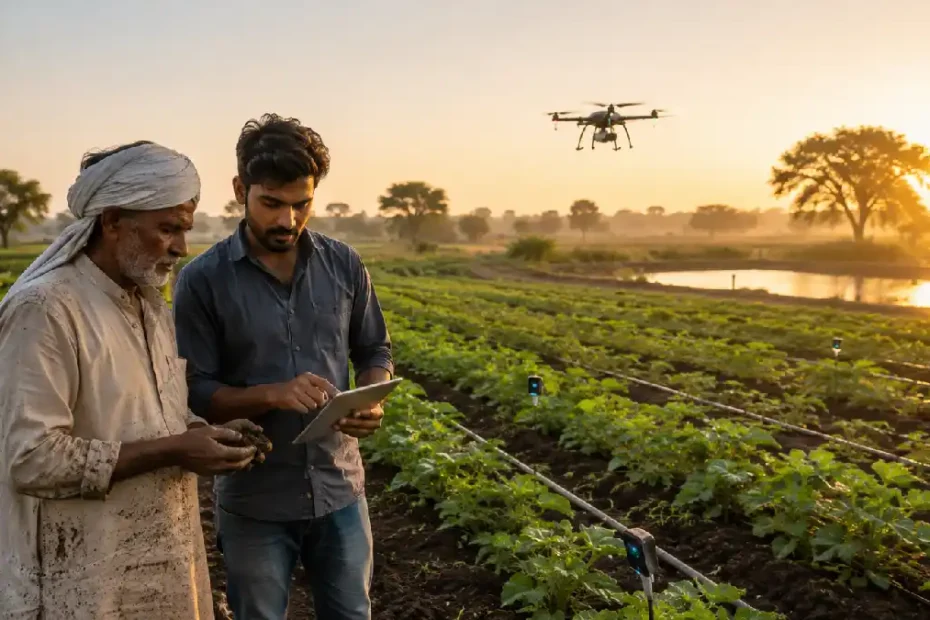
In farming, traditional cultivation is based on generations of trials, observation, and deep ecological wisdom. To bring the process to its peak, traditional farming employed practices such as multi-cropping, natural soil replenishment, and monitoring weather updates. These practices help farmers keep the balance between the ecosystem and the community fed.
But in modern days, modern agriculture faces all kinds of challenges. From changing weather to soil erosion, modern agriculture handles both matters very gently and makes the farming system stronger and faster. However, some of the farmers believe that modern technologies or techniques will overwrite the time-tested methods.
Through this Farm article today, we are trying to express that traditional agriculture does not mean you have to drop heritage. Instead, smart integration that keeps it going, treating technology as an amplifier for that older knowledge, so you end up mixing generational intuition with real-time, data-driven accuracy. In other words, it’s more like wisdom plus insights, rather than a complete break, and it all feels a bit more grounded than people assume.
Why Modern Technology Is Important In Farming
The traditional farming system is a practice of several years and experience. Integrating modern technology doesn’t mean replacing the whole traditional system; rather, it is a blending of tradition and the modern era to create a sustainable farming system as a long-term investment.
It Develops Crop Production
Modern tools like precision farming, GPS guidance, and smarter irrigation help farmers optimize planting, watering, and fertilization too. In the end, you get healthier crops and a higher yield, but also without using too much water or spending extra on other resources. It’s like less waste, more steady growth, and more control over what the land does for you. It’s a better routine overall, not just a random upgrade.
A support to sustainable Agriculture
By mixing older practices like crop rotation with organic composting, and then adding modern technologies, it helps keep the soil condition stable, saves water, and also lowers the overall environmental footprint, a bit. It is a bond that traditional wisdom meets newer tools, so the land stays healthier longer.
It Can Control Crop Losses
Early detection tech, drones, as well as crop monitoring setups, can help spot pests, plant diseases, and nutrient gaps before they get a chance to spread. This protects yields, improves overall crop quality, and makes the whole growing process smoother, even when conditions are weird.
Greater Labor Efficiency
Today, modern gear like seed drills, power tillers, and automated sprayers makes the whole process feel quicker. It reduces the amount of manual work and lets farming operations run more efficiently, even when the timing is tight.
Encouragement to next-generation farmers
When farms start using drones and AI, and these kinds of mobile applications, plus smart farming tech, it can make agriculture feel more inviting for younger people, and really that helps reduce those labor gaps too. It also pushes new thinking in the sector, like experimentation that maybe was harder before.
Check out The 6 Ways To Integrate Technology With Traditional Farming
Introducing modern technology is not a replacement; it’s a process to save livelihoods and keep the traditional methods alive. So, let’s find out how we can blend the modern techniques with tradition to create sustainable agriculture.
Solution 1. Change the mindset, not the replacement
If you want to improve your agriculture on the farm, then the first thing is to change your mindset and not let the decision be an option like “either/or”. Make your decision, accept the truth, and balance the whole condition because
- Traditional wisdom works by understanding local crop varieties, seasonal microclimates, and soil biology.
- Whereas you cannot only assume the variety and condition of the soil but also can measure the exact moisture levels, balance the nitrogen in the soil, and monitor climate changes.
Solution 2. Manage soil using IoT sensors
In ancient times, farmers used to judge whether the soil was appropriate for cultivation or not by its colour, texture, and odour. But in the present day, soil has been found to get polluted for several reasons. This destroys soil’s fertility and its important elements. These micro-disbalances or chemical imbalances can not be dug out by a visual inspection. That’s where technological integration is needed! Integrating modern technology like IoT sensors will help to detect chemical imbalances or deep subsurface moisture levels before symptoms appear in crops.
We can merge both traditional and modern integration in two ways.
Phase 1: Merge organic matter with targeted testing
Confusion in measuring the organic factor of the soil? Still keep the basic building of soil, like composting, using green manure and cover cropping?. Then use low-cost IoT soil sensors to keep an eye on soil nitrate levels and pH in real time, more or less. That way, organic amendments are put out only when needed, instead of “just in case”, and it helps stop nutrient leaching.
Phase 2: Monitor Moisture and soil imbalance with sensors
If you want to treat your crops with the best cultivation process, then ignore the common detection process of the soil surface. Rather, use monitoring sensors that can be operated through a smartphone from anywhere, anytime, for a weather update and water requirements in the soil.
Solution 3. Save water with indigenous methods with a smart system
Lots of traditional farming cultures came up with new ingenious water management setups, like terraced fields, rainwater capture, or even the clay pot for irrigation. When you mix these old-school approaches with current drip automation, it can become a more resilient, low-impact way to irrigate.
How to save water for future cultivation?
- Step 1: Traditionally, you can go through rainwater harvesting ponds or natural catchment basins, or groundwater.
- Step 2: While traditional ways are lengthy and time-consuming processes, you can follow the same thing by adding automated deep irrigation lines to save water for future smooth crop cultivation. With automated solenoid valves linked to weather forecast data, the whole setup just pauses watering whenever rain is predicted, cutting water usage by as much as 40% compared to the usual flood irrigation. It’s a simple idea, but it helps a lot.
Solution 4. Protect the crops with Automated systems
Protecting the crops for better farming is basic security. Traditionally, we use natural predators, companion planting, and crop rotation to control soil damage. But according to the present climate and soil conditions, pests have become more powerful, and removing them requires high chemical suspensions that impact soil fertility. Here, a simple change can protect the soil without hampering the traditional method.
Introduce Multispectral drones
Along with traditional inspection, multispectral drones will spot the early stress signals in those companion plots before the infection starts to spread visually.
AI disease identification apps with Insect predators
Together, they will work to gather the snaps of each specific pest and their harmful effects so that we can use organic spray on the specific wounded crop. This not only prevents the damage but also decreases the use of pesticides.
Crop rotation with digital mapping of fields
Track 5- to 10-year crop rotation history over the field plots, just to keep soil disease agents from piling up in the ground.
With drones that come with NDVI (Normalized Difference Vegetation Index) cameras, farmers can sweep dozens of acres in just a few minutes. The drone finds the specific plants that appear stressed, so the farmer can go straight to the exact problem area, then use precise plant-based extracts instead of doing generic blank spraying across the entire field.
Solution 5. Seed Preservation and Biodiversity
Monoculture is a big issue in the farming industry as cultivators depend on a single seed that pushes the crop heritage to widespread failure. Traditionally, farmers save seeds by preserving the heritage and local conditions for many decades. Now, we can bring technology to protect the seeds for future use.
Prepare digital seed banks.
Community gardening groups like to use cloud-based databases to sort through local heirloom seed kinds, like indexing them for real life, and then they write down ideal growing contexts, germination percentages, plus harvest traits, all in a way that feels like practical, not just theoretical.
Microclimate machine
Machine learning platforms use local weather information in order to spot tiny microclimates all around a farm, so it can figure out where these heritage seed types usually do better. In other words, it’s like finding a more niche growing pocket for each variety.
Solution 6. Step-by-Step Implementation For Better Understanding
In the traditional form, most of the farms used to make transactions through a single port. But truly, it’s an unnecessary decision that can even be risky for the crop fields as well as the crops. It’s better to follow some steps to implement technical methods with proper understanding.
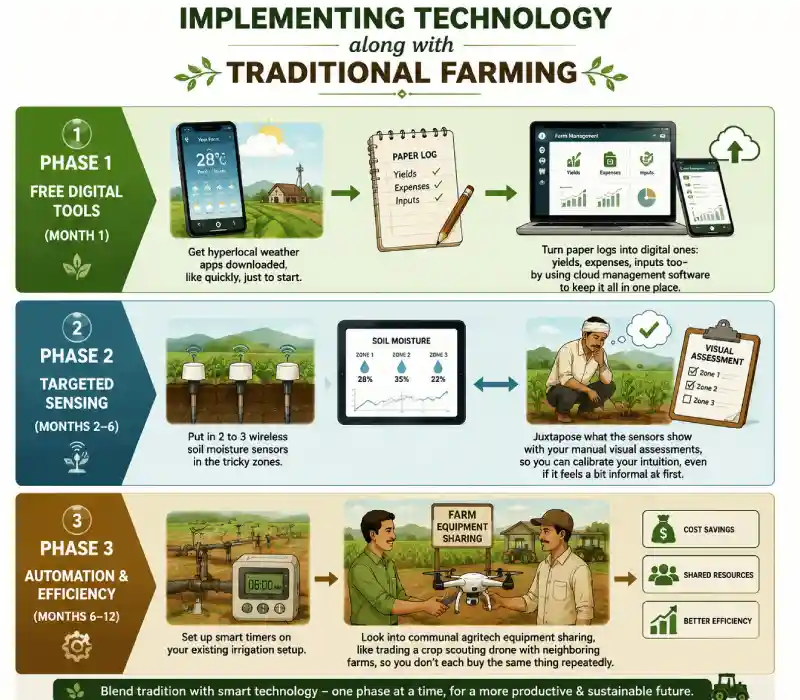
Phase 1, Free Digital Tools (Month 1)
- Get hyperlocal weather apps downloaded, like quickly, just to start.
- Turn paper logs into digital ones: yields, expenses, inputs too- by using cloud management software to keep it all in one place.
Phase 2: Targeted Sensing (Months 2–6)
- Put in 2 to 3 wireless soil moisture sensors in the tricky zones.
- Juxtapose what the sensors show with your manual visual assessments, so you can calibrate your intuition, even if it feels a bit informal at first.
Phase 3: Automation & Efficiency (Months 6–12)
- Set up smart timers on your existing irrigation setup.
- Look into communal agritech equipment sharing, like trading a crop scouting drone with neighboring farms, so you don’t each buy the same thing repeatedly.
Conclusion
Traditional farming is based on several practices over many decades. Farmers can identify the soil by its texture, moisture level, and odor. Their processes are lengthy but have the means to handle all the issues. But in this fast-paced generation, the traditional methods have become slow and limited for a big farming industry. Integrating new modern technologies into this industry can be a reason to follow recent trends. Maybe the new generation is a little faster, but they are based on the traditional system and follow it to improve farming and maintain sustainability. The following article sheds light on the important factors that show how important it is to integrate modern technology into the traditional farming system.
FAQs
Traditional farming is important in recent days as it promotes environmental sustainability, protects biodiversity, and preserves soil health.
Yes, it changes a little, as modern technology is faster and uses data-driven methods.
It is more important to save the natural environment and water, and protect crops rather than just cultivation.
It improves crop fields and production, reduces labour, and saves water and chemicals.
Farmers can still carry on with things like crop rotation, mixed cropping, saving seed, organic composting, and indigenous pest control, while at the same time using technology to keep an eye on conditions, do better planning, and manage resources in a tidier way.
Not necessarily, you know how it goes. A lot of those bargain technologies, plus these different government subsidy programs, and the agricultural extension services too, they together make modern farming toolsets a little more affordable in real life for small to medium-sized growers.
Major issues that farmers can face include high cost, poor rural infrastructure, and lack of technical training.