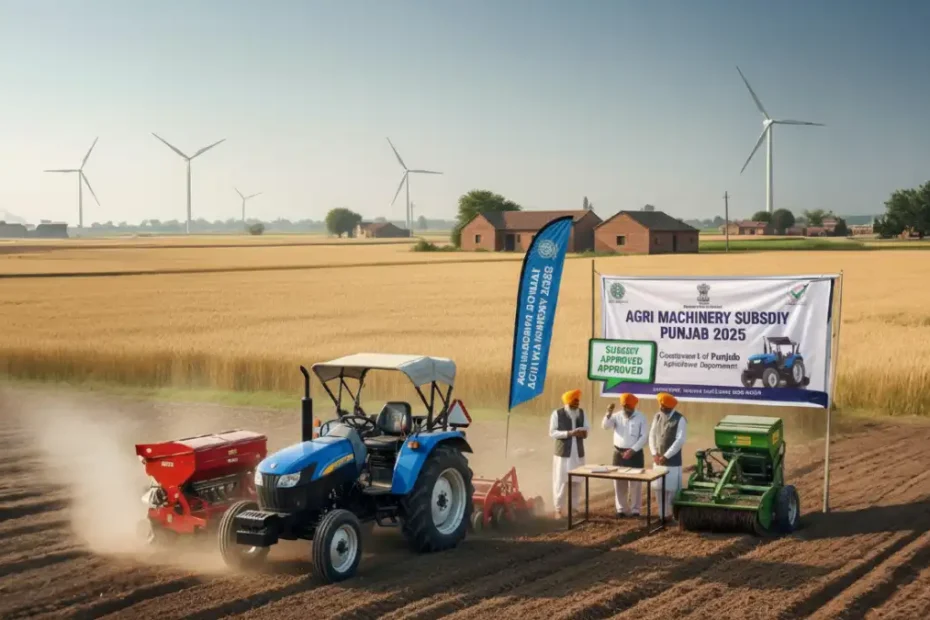
Farming in Punjab is vital, but new machines cost a lot of money. Things like modern tractors, better seed drills, or equipment to manage crop stubble can be too expensive for many farmers.
The government knows this is a problem. That’s why they created the agri machinery subsidy Punjab Scheme. This program gives farmers financial help to buy the modern equipment they need. It makes advanced farming tools much more affordable and easier to get.
This guide is written to make everything clear. We will show you exactly how this subsidy works, including why new machines help your farm, what specific machines get the subsidy in punjab, if you can checking eligibility, the step-by-step process to apply for the money, tips for choosing the right machine, extra ways to pay for the machine besides the subsidy, how to use and take care of the new equipment.
Ready to make your farm work easier and earn more? Let’s start with the basics of the subsidy.
Why does farm mechanization matter in Punjab?
Punjab is a powerhouse of Indian agriculture — but that success also brings pressures: labour shortages, rising wages, and environmental stress like stubble burning. Mechanization helps solve all three. Think of good machines as partners that let you do more, faster, and cleaner — and that’s exactly why subsidies exist: to make that partner affordable.
✅ Benefits of adopting modern machinery
- Faster field operations (less time between sowing and harvesting).
- Better timeliness, which improves yields.
Lower labour dependency and reduced drudgery. - Tools for tackling residue (happy seeders, mulchers) that reduce burning and pollution.
Common concerns farmers have
- “How will I pay the rest of the cost?”
- “Who will service the machine?”
- “Is the machine right for my small field?” — all valid.
The rest of this guide answers them step by step.
What is the Agri Machinery Subsidy?
The agri machinery subsidy is financial assistance (a % of the purchase price) given to farmers to buy approved farm machinery and implements. There are two layers: central schemes (like the Sub-Mission on Agricultural Mechanization — SMAM) and state-level programmes that top up or implement these schemes locally. SMAM sets national guidelines while Punjab customizes delivery and adds state-specific drives and budgets.
Central vs. State role (SMAM & state schemes)
- Central (SMAM): Provides overall scheme structure, eligible equipment lists, and funding patterns for many initiatives, like subsidies and Custom Hiring Centres.
- State (Punjab): Allocates budgets, runs local application portals, and may launch special drives (e.g., state procurement targets, DBT). Punjab has been active with specific allocations and campaigns.
Typical subsidy rates and who qualifies
Under SMAM and most state implementations:
- Individual farmers often receive around 50% subsidy on selected implements (varies by equipment).
- Special higher rates (up to 80%) are often provided to groups/cooperatives, women farmers, SC/ST categories, and for machines addressing pollution, like CRM tools. Exact rates and caps depend on the year and scheme.
Punjab’s recent subsidy initiatives (what’s new)
Agri machinery subsidy Punjab has been stepping up: in 2024–25, the state announced targeted funds and machine distributions to tackle stubble burning and upgrade farm tech.
Rs. 21 crore scheme & DBT rollout
Punjab announced a ₹21 crore push for agricultural mechanization that emphasized Direct Benefit Transfer (DBT) to ensure transparency and quicker payments to farmers buying subsidized machines. This was intended to expand access and reduce middleman hassles.
Big plans to combat stubble burning (machines & targets)
Punjab rolled out larger action plans (e.g., multi-hundred-crore investments) to provide thousands of crop residue management (CRM) machines — happy seeders, mulchers, balers — alongside penalties and incentives to reduce burning. These programmes aim to distribute machines to farmers and service providers through subsidies and targeted procurement.
Which machines are usually subsidized in Punjab?
Government lists change, but commonly agri machinery subsidy Punjab include:
Crop Residue Management & eco-friendly equipment
Happy Seeder, Super Seeder, Zero-till drills, Mulchers, Baler, Straw choppers — prioritized for fighting stubble burning. Many of these attract higher subsidy percentages.
Other common implements
Tractors (state-specific schemes sometimes), rotavators, seeders, planters, power reapers, balers, paddy transplanters, combine harvesters, and spray equipment. Custom Hiring Centres (CHCs) are also funded to make machines available to smallholders without full purchase.
How to check eligibility (who can apply)?
Eligibility is typically defined in the scheme notification, but common criteria include:
- Registered farmer (land records) or farmer-group/cooperative.
- Aadhaar and bank account linked for DBT.
- No outstanding disqualifications (varies by scheme).
Special beneficiaries
Women farmers, small & marginal farmers, SC/ST categories, and farm machinery service providers often get priority or higher subsidy slabs. Always check the current notification for exact categories and caps.
Documents you’ll typically need
Aadhaar, land ownership proof (or lease), bank details (for DBT), farmer ID or e-KYC, and sometimes income or caste certificates for special categories. Dealers may ask for additional forms during purchase.
📝 Step-by-step application process
Here’s a farmer-friendly walkthrough to get the agri machinery subsidy Punjab.
1. Where to apply (portals & district offices)
- Check the central platform (AgriMachinery / SMAM portals) and Punjab’s agriculture department site or designated state portal for announcements and application links. In recent years, Punjab has used online portals and collectorate offices for filings.
2. Choose approved equipment & dealer
- Buy only from approved models and registered dealers. Manufacturers/dealers typically upload product prices for approval on the central/state platform, so the subsidy calculation is standardized.
3. Dealer/manufacturer role and price approvals
- Dealers register the sale and help file subsidy claims. The product price often must be approved by state/district officers before subsidy release. Keep invoices and warranty papers safe.
4. Verification, DBT & delivery
- After application and verification, the subsidy is usually disbursed via DBT to the farmer’s bank account or used to issue a discount at purchase, depending on the scheme flow. Expect physical verification of delivery in many cases.
Tips to choose the right machine
Buying machinery is a long-term decision — here’s how to make it wise.
Match the machine to the farm size & cropping system
Don’t buy the biggest tractor because it looks powerful. Match horsepower and implement size to your field plots, soil type, and crops.
Warranty, service network & parts availability
Pick brands/dealers with a local service center and spare-part availability. A machine is only as good as the after-sales support.
Consider operating & maintenance costs
Fuel, gearbox oil, tines, and operator training add to lifecycle cost. Estimate the total cost per acre before buying.
Financing options beyond subsidy
If the subsidy covers only part of the cost:
Bank loans & Kisan Credit Card (KCC)
Many banks offer equipment loans with competitive rates; KCCs can be used for short-term machinery needs. State banks sometimes run special agri-equipment financing tie-ups.
Group buying and Custom Hiring Centres (CHCs)
If buying is expensive, consider joining or forming a CHC, cooperative, or group purchase to share costs and usage. CHCs are supported under SMAM to increase access.
Best practices after purchase
You got the machine — now protect your investment.
✔️ Operator training & safety
Attend training camps (often run by extension services), read manuals, and use PPE. Skilled operators improve efficiency and machine life.
✔️ Proper storage, maintenance & record-keeping
Store implements under shelter, keeps service logs, and follows scheduled maintenance. These records help if you need warranty claims or future resale.
Common problems & how to solve them
Delays in subsidy payment / low utilization of CRM machines
Delays happen due to verification backlogs, paperwork errors, or portal glitches. Keep copies of submissions and follow up at the local agriculture office. Low utilization of residue machines has been an issue; monitoring and incentives are being strengthened.
What to do if your application is rejected
Get the rejection reason in writing, correct the document or eligibility gap, and reapply. If appeal options exist, use the district agricultural office grievance cell.
How Punjab monitors use (GPS, i-khet, audits)
Punjab has experimented with GPS tracking and online monitoring (like i-khet) for subsidized CRM machines to ensure they are used during the season. Some practical issues—like trackers needing power on passive implements—have required adaptation (e.g., installing trackers on tractors instead). Monitoring helps show impact and prevents misuse, but it also raises practical and data-privacy questions.
Future trends: what to expect next
- Electrification: battery/electric tractors and implements will slowly enter the market.
- Precision & data-driven farming: sensors and IoT add-ons for better efficiency.
- Local manufacturing push: more state-level procurement to support local makers.
- Greater focus on the environment: more machines targeting residue and water conservation will be prioritized.
Quick checklist for farmers (one-page action plan)
- Check the latest state notification on the Punjab Agriculture Dept. website or the AgriMachinery portal.
- Shortlist machines matching your farm size & crops.
- Verify approved models and dealer registrations.
- Prepare documents (Aadhaar, land proof, bank) and apply online/offline.
- Keep invoice, warranty, and service records after purchase.
- Attend operator training and follow the maintenance schedule.
Conclusion
Agri machinery subsidy Punjab is a real opportunity — especially for farmers who want to modernize, save labour costs, and tackle environmental issues like stubble burning. The system combines central guidelines (SMAM) with state-level initiatives, DBT processes, and targeted campaigns. The key is to check the current scheme notification, choose the right machine for your land and crops, buy from approved dealers, and maintain the machine properly. With smart choices, the subsidy can turn an expensive purchase into a farm asset that pays back season after season.
FAQs
Q1. Where can I find the current list of subsidized machines for Punjab?
Ans: Check the central AgriMachinery portal and the Punjab Agriculture Department website for the latest approved equipment lists and state notifications. Dealer kiosks in district agri offices often carry these lists too.
Q2. How much subsidy will I get on a happy seeder or mulcher?
Ans: Subsidy percentages vary by year and beneficiary category. Historically, CRM tools like happy seeders often receive higher support (50% or more; groups/cooperatives sometimes up to 80%) — always confirm in the current notification.
Q3. Can small and marginal farmers get a preference?
Ans: Yes. Many schemes prioritize small & marginal farmers, women, and SC/ST beneficiaries with higher subsidy rates or simplified procedures. Check the scheme eligibility for the exact criteria.
Q4. If my field is small, should I buy or use a Custom Hiring Centre (CHC)?
Ans: If your landholding is small, a CHC or renting through a cooperative is often more economical than buying. CHCs are supported by central/state schemes to improve access.
Q5. What should I do if the subsidy payment is delayed?
Ans: Keep copies of your application and payment acknowledgements. Visit the district agriculture office, raise the issue through the official grievance channel, and ask the dealer to follow up with the state nodal officer. If the scheme uses DBT, confirm your bank details and Aadhaar linkage.